Sunday, March 3, 2013

A pair of predators

It's not unusual to find predators on the reef.  But today, we found 2 in close proximity, at about 50 feet.  That made for an interesting photo.

First, the two-toned longlure frogfish.  It is an ambush predator, and lures prey in, using its lure appendage.


Second, the spotted moray. It is a pursuit predator, and feeds mostly at night.


The frogfish in the foreground, and the moray behind.


Saturday, March 2, 2013

Sea slug

On our morning dive, we encountered a lettuce sea slug.  It was less than an inch long, in about 10 feet of water.  Their color helps them blend in with algae, which they eat.  Sea slugs absorb oxygen through their skin.  The ruffles on the back provide more surface area for oxygen absorption. The head end can be recognized by the pair of tentacles that look something like rolled paper.


In all these photos, the head is on the left side.  Now that you know what they look like, see if you can find the lettuce sea slug below.


Friday, March 1, 2013

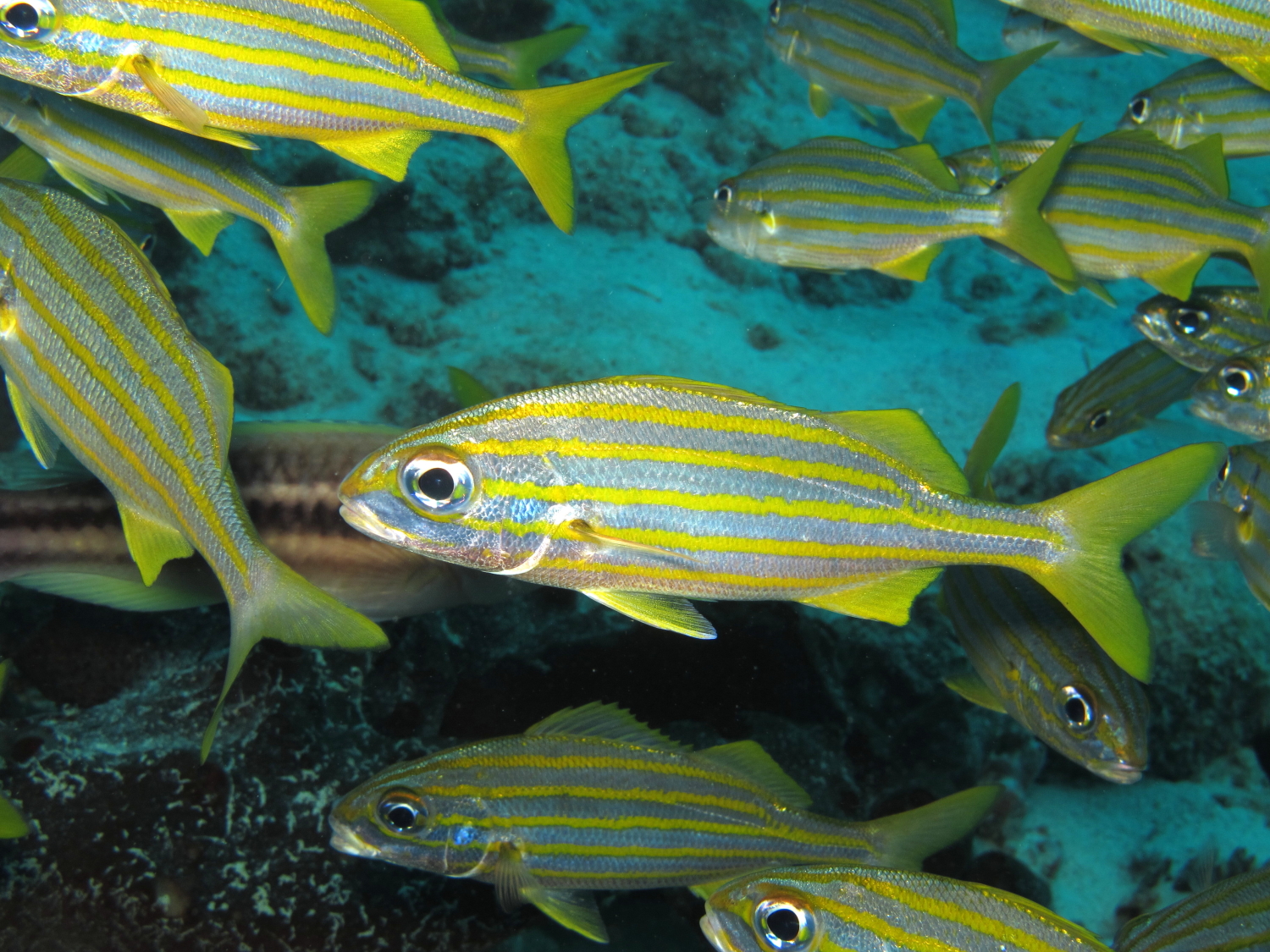
Smallmouth grunt

As you might guess, the grunt family is named for a sound that they produce.  This sound begins with teeth grinding deep inside the throat, and is then amplified by the air bladder.  They certainly don't grunt all the time. I don't think that I have ever heard it.


Several species of grunt occur in Bonaire.  The smallmouth grunt is one of the 2 most abundant grunt species, here. During the day, we often see large numbers of them milling around in reef shadows.  Most of the ones we encounter are between 6 and 8 inches, but we also see juvenile stages that are much smaller (about 2 inches), often in shallow water over fire coral reefs.


Thursday, February 28, 2013

Spotted trunkfish

The spotted trunkfish is a member of the boxfish family.  They can grow as long as 12 inches, but most of the ones we see are closer to 6 or 8 inches. Most often, we encounter them hiding in recesses in the reef.


It's always fun to find them swimming above the reef.  This fish was hiding in a lavender rope sponge. All the photos were taken between 30 and 40 feet deep.


Wednesday, February 27, 2013

Stovepipe sponges

First of all, sponges are animals. They are nourished by filtering food and oxygen out of the water that passes through them. The water goes into the sponge through many small in-current pores, and exits the sponge through large ex-current openings.

Bonaire has an incredible variety of sponges, of various shapes and colors.  Stovepipe sponges are tube sponges that resemble stovepipes. Water flows in through the pores in the sides (see below), and out via the stovepipe.  Cleaning gobies often live inside them.


They are generally quite symmetrical, as you might expect.


But every once in a while, we find stovepipe sponges that seem to have lost their direction, as below.


Tuesday, February 26, 2013

Whitespotted filefish

Despite their name, whitespotted filefish don't always show their spots.  Sometimes they display an orange phase. They can easily change the number and brightness of their spots.  They swim slowly over the reef, often in pairs. These fish were all about 12 to 14 inches long.  The file is the first dorsal fin, and in each of these photos, it is lying along the back, starting just above the eye.


Filefish swim gracefully, propelled largely by wave-like action along their yellow dorsal and anal fins. These photos were all taken at depths of 30 feet or less. The file is erected during some tight turns, but it may also be used to communicate with other filefish.


Monday, February 25, 2013

Black durgon

The black durgon is a member of the triggerfish family.  It has a black body that is accented by pale blue lines at the base of the dorsal and anal fins.  The blue lines are visible from quite a distance. This fish gracefully propels itself largely by moving its dorsal and anal fins.

When you get close to the black durgon, with the right lighting, it becomes apparent that the fish is not solid black, but a delicate pattern of lines and diamonds, with a yellow cast on the head, and pale blue lines through the forehead.


In the below photo, the trigger is visible, as the first dorsal fin.