Thursday, February 13, 2020

Long nose

Of the myriad of butterflyfishes with yellow, white, and black markings that occur here, the longnose butterflyfish (lau wiliwili nukunuku 'oi'oi) has the most distinctive profile, with its very long snout.


It also has a dark color phase, which I had never encountered before.

Dark phase longnose butterflyfish heading to the right.
Tail visible to the left.


Sunday, February 9, 2020

Just below the surface

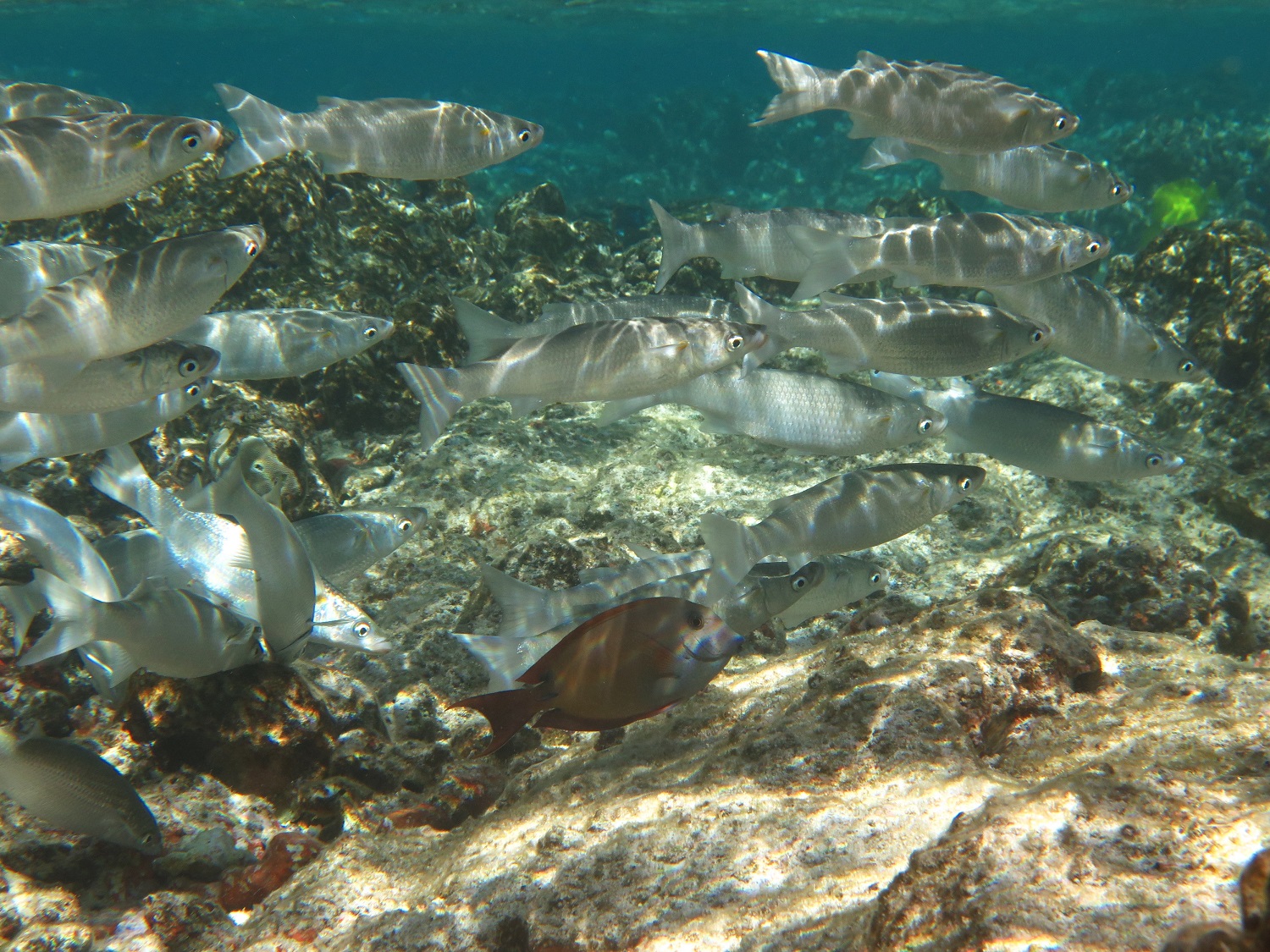
Today, for the first time this trip, we encountered schools of sharpnose mullet (uouoa) in very shallow water, just below the surface of the bay.  It was hard to swim close to them, without endangering ourselves on the rocks and coral below.  They were about 10 inches long.


Mullet with a few yellow tang

Mullet with a brown surgeonfish


Also just below the surface, we saw small groups of acute halfbeaks (iheihe).  We often see a few of this species, but photographing them is tricky, with ambient light and focus issues.  They are interesting to watch as they cruise at the top of the water column.  They were also about 10 inches long.


Friday, February 7, 2020

Down south

Last week, we headed to the north end of the island, today we drove down to South Point, the southmost point in the US.  The day looked dismal and gray to the south, but sunny with blue sky to the north.

Looking north, at the slope of Mauna Loa.  The sculptured hands 
in the foreground has the inscription:
Kingdom of Hawaiians is still here.  We never left.

The cliffs looking south

The cliffs, looking north

Always an interesting site to visit.  Today, we spoke to one man who was fishing in shallow tidepools on the very southern end of South Point, using a throw net, and he was gathering limpets from the rocks.

Tossing the net, as waves are breaking behind him

The net gathered up


And for a change, today we saw free-range cattle as well as chickens and ducks.


Wednesday, February 5, 2020

A fast swimmer

This morning, we were delighted to catch a glimpse of a beautiful, fast-moving fish, the bluefin trevally (omilu).  This one was about 24 inches long and we hardly had time to aim our cameras at it.  Somehow, Bori's new camera focused on it, and took a great shot.


Tuesday, February 4, 2020

Grouper

Today our snorkel was graced by quite a few peacock grouper (roi).  This species was introduced to the Hawaiian islands in 1956, from Moorea (and its Tahitian name "roi" came with it).  Up until today our sightings of these fish have largely been fleeting glimpses, as they head into crevasses.  Sometimes we watch them watching us.

The peacock grouper is really a lovely fish.  With the right light conditions, their bright blue spots and bands on the fins look spectacular.  But you can judge for yourself.

The rainbows were produced by sunlight in fairly shallow water.

This grouper was in a cleaning station, but the cleaner wrasse is not in the photo.

A group of three grouper, perched on the bottom.


A beautiful bay day

This morning, we got a jump on the crowd and headed out to kayak across Kealakekua Bay to Captain Cook's monument, not far from where he was killed by Hawaiians, in 1779.  The bay is quite spectacular, so this post features what the bay looks like.

A panorama of Kealakekua Bay, from the SE

In the distance you can see the Capt. Cook monument

A slightly closer view

Captain Cook monument

Upon reaching the monument, jump into the water and tow the kayak behind you

Sunday, February 2, 2020

What the eel?

We often look in crevasses and under coral heads in search of moray eels.  So far, I think we have seen at least 5 different species.  Occasionally, we see eels out in the open.  But most often, we catch a glimpse of a piece of the eel's mid-section, then hope to find its head.


Below is a typical view of an eel.

Possibly an undulated moray (puhi lau milo)


And here are a couple of head shots.

Yellowmargin moray (puhi paka)

Snowflake moray (puhi kapa)